Kakobuy Kitchen Work Shoe Spreadsheet Guide
Kakobuy Kitchen Work Shoe Spreadsheet Guide
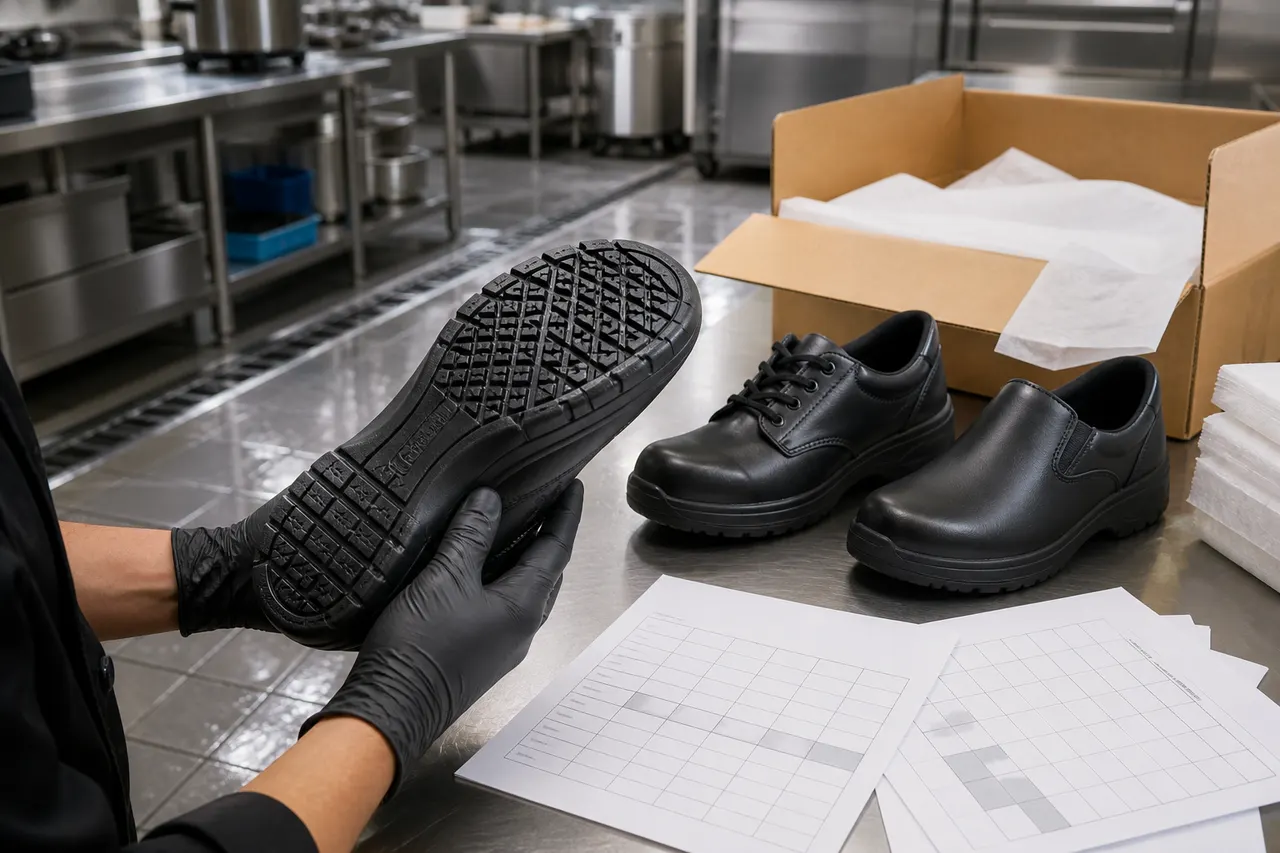
Kitchen work shoes cannot be decided solely by a "non-slip" label or appearance. Grease, water, cleaning agent residue, wet tiles, and long periods of standing bring different risks, and ordinary product photos usually cannot prove the grip performance of the sole in a real kitchen. The task of this guide is to help you use the Spreadsheet at kakobuyspreadsheetshoes.com to build a candidate list, then combine product page information, seller confirmation, and Kakobuy warehouse QC photos to complete pre-order screening.
After reading, you should be able to eliminate candidate shoes with unsuitable structure, difficult cleaning, or insufficient information, and organize items that need to be confirmed with the seller and warehouse. This guide is not suitable for positions that require legally certified shoes, safety-toe shoes, insulated shoes, or other mandatory personal protective equipment; such positions should be based on employer policies, local regulations, and verifiable certifications.
The Kakobuy service information mentioned in this article is organized based on the platform materials provided this time, with a verification date of August 27, 2026. Fees, exchange rates, routes, delivery times, inventory, return/exchange conditions, and platform policies may change, and should be reconfirmed on the Kakobuy page, product page, and checkout page before payment.
First clarify kitchen position, floor environment, and wearing duration
Write down the usage scenario before opening the Spreadsheet. Different positions have different requirements for shoes: the dishwashing area often encounters standing water and cleaning agents, near the stove is more likely to have oil stains, the baking area may face flour and fine particles, and moving between the front of house and back of house also needs to consider appearance, walking noise, and turning stability.
It is recommended to record the following information first:
Main position, and whether frequently moving between front of house and back of house
Floor material, such as tile, epoxy floor, anti-slip mat, or metal tread plate
Main contaminants: water, grease, cleaning agents, or food debris
Wearing time per shift, and the proportion of standing, fast walking, turning, and carrying
Whether the employer requires toe protection, water resistance, specific colors, or verifiable non-slip standards
Whether removable insoles, wide fit, arch support, or orthotic insole space is needed
If the position has clear occupational safety standards, sole patterns or seller-written "non-slip" cannot replace certification documents. ⚠️
How the Spreadsheet helps build a kitchen work shoe candidate list
The Spreadsheet at kakobuyspreadsheetshoes.com is more suitable for discovering and organizing candidate products, rather than making safety determinations for you. It can turn scattered product entries into a comparable shortlist, but you still need to open the corresponding product pages to verify names, specifications, sizes, prices, inventory, and seller information.
When building a candidate list, you can keep these fields:
Field | What to record | Handling when information is insufficient |
|---|---|---|
Usage scenario | Wet area, greasy area, front/back commute, or long standing | Eliminate if it doesn't match the position |
Shoe structure | Toe cap, heel counter, upper, and opening style | Ask seller when images and options are inconsistent |
Sole information | Tread direction, groove depth, flex zone, and material description | Do not treat "non-slip" text as test results |
Cleaning conditions | Seams, mesh, decorative holes, and removable insoles | Lower priority for styles that cannot be cleaned |
Size basis | Size chart, insole length, foot width, and option units | Delay order if only generic sizes are available |
Transaction terms | Product price, domestic shipping within China, return/exchange restrictions, and specifications | Reconfirm before payment |
The value of a spreadsheet is making elimination reasons traceable. For example, don't just write "style not good," but write "open back, does not meet the carrying needs of this position" or "seller did not provide insole length." This way, even if product links, prices, or inventory change, the screening logic remains valid. 📋
Screen shoe types by toe cap, heel counter, and upper structure
The toe cap structure primarily affects splash and impact protection. Closed toe caps are generally more suitable for kitchens than open-toe styles, but they do not automatically mean safety-toe shoes. If the position requires safety toe caps, verifiable standards, model numbers, and certificates should be checked, not inferred from appearance.
The heel counter structure affects stability during quick turns and carrying. A full heel counter is usually more stable; adjustable back straps need to check the fastening method and stress points; completely open slipper-style heels are easy to put on and take off but may increase the risk of slipping off on wet floors, stairs, or rapid movement. Ultimately, workplace regulations should be followed.
Uppers can be sorted by cleaning difficulty: uppers with continuous surfaces and minimal decoration are usually easier to wipe; multi-layer stitching, deep seams, and large areas of mesh are more likely to accumulate grease or liquids. At the same time, completely non-breathable uppers may increase stuffiness, so they need to be judged in combination with shift length, sock changes, and rest conditions, not just pursuing "waterproof."
When screening, also check whether the shoe opening rubs the foot, whether the tongue shifts easily, and whether the lining stays flat. When the product page cannot prove these experiences, mark them as unknown rather than listing them as advantages.
Verify sole tread, flex zone, and boundaries of non-slip information
Sole images can support structural checks, but cannot prove actual friction performance. Prioritize checking for complete outsole front view images, and observe:
Whether both forefoot and heel have clear grooves, not just decorative in the midfoot area
Whether the tread has multi-directional drainage paths
Whether large smooth areas may accumulate water or adhere oil film
Whether the forefoot flex position roughly corresponds to the gait area
Whether the outsole edges are intact and left/right tread patterns are consistent
Whether the seller states outsole material, applicable surfaces, and test standards
"Rubber sole," "wear-resistant sole," and "kitchen non-slip" are not the same evidence. Material names alone cannot predict performance on greasy tiles, and deep treads are not necessarily suitable for all contaminants. If the seller claims compliance with a non-slip standard, ask for the standard name, test method, applicable model, and verifiable documents; without such information, treat it only as a seller description.
After receiving the shoes, do not test them directly in high-risk work areas. First, in a safe and controlled environment allowed by the employer, check fit, sole contact, and stability. 🧑🍳
Compare uppers based on grease, splashing, and cleaning frequency
For positions with frequent grease contact, prioritize structures with surfaces that are easy to wipe, fewer seams, and do not absorb a lot of dirt. For dishwashing areas, focus on checking whether the shoe opening, tongue, and seams easily let water in. Here, distinguish "water-repellent" from "waterproof": unless the product page provides a clear scope and verifiable basis, do not expand the former to mean prolonged immersion.
Cleaning frequency also changes the choice. If wiping multiple times a day, complex stitching, fabric coverage, and hard-to-reach grooves increase maintenance time; but an overly smooth outsole may lack drainage space. Candidate shoes should balance easy cleaning with necessary tread.
Also check whether the seller provides cleaning restrictions. Hot water, strong alkaline cleaners, chlorine products, or machine drying may affect adhesives, coatings, and outsoles; do not assume the shoes can withstand all kitchen cleaning processes. If not stated, ask the seller before payment and keep a record of the reply.
Judge long-wear space from size chart and insole length
Do not directly convert from your usual US, EU, or Chinese size. Different sellers, lasts, and batches may vary, and the most useful comparison basis is usually foot length, foot width, insole length, and the measurement method noted by the seller.
Record according to these steps:
Measure both feet length and widest part while wearing work socks at a time when feet are more swollen during the day.
Use the larger foot as the base data.
Check whether the product size chart indicates foot length, insole length, or inner length.
Confirm with the seller the actual inner length, forefoot width, and whether a wide fit is available for the target size.
If orthotic insoles are needed, confirm whether the original insole can be removed and whether the internal height is sufficient.
Do not mechanically add one or two sizes. Too short will squeeze toes, too long may cause the foot to slide when turning; too wide and too narrow also affect stability. When the seller cannot provide key dimensions, prioritize candidates with more complete information.
QC photo check of sole, seams, and left-right consistency
Kakobuy's inspection materials state that its routine inspection mainly checks style, quantity, color, size, model, and other appearance information, and conducts prohibited item screening. This type of QC can help detect obvious wrong items or appearance problems, but cannot replace wear testing, non-slip experiments, or occupational safety certification.
After the shoes are in the warehouse, within the available service scope, focus on:
Whether the shoe box label, size label inside the shoe, and order specifications are consistent
Whether the left and right shoes are consistent in color, upper material, tread, and height
Whether the outsole is intact, with no obvious glue gaps, cracks, edge lifting, or abnormal deformation
Whether the upper seams are continuous, and toe cap and heel counter are symmetrical
Whether insoles are complete, and whether there are obvious protrusions or contamination inside
Whether the outsole photos are clear enough to verify tread and left-right consistency
If existing photos do not cover the sole or size label, within the scope allowed by the platform, ask whether additional required angles can be supplemented. QC photos only reflect the appearance visible at the time of shooting, and cannot be used to claim that the shoes have passed wet, greasy, or long-shift tests. 🔍
Problems should be addressed as soon as possible. The provided platform materials show that general products support five-day no-reason return/exchange within 120 hours after warehousing, but customized, restricted, intimate items, and products where the warehouse has been asked to remove packaging, tags, or accessories may not apply. This policy and specific product eligibility are time-sensitive and should be based on the page and customer service confirmation on the day of application.
Confirm specifications, return/exchange conditions, and shipping information before ordering
Before payment, reopen the product page, confirm the link is still valid, and verify the selected color, size, shoe type, quantity, price, inventory, and domestic shipping within China. Take screenshots or record seller replies regarding insole length, outsole material, cleaning method, and certification documents to avoid keeping only possibly outdated summaries in the Spreadsheet.
According to the provided materials, Kakobuy as a Chinese product purchasing agent, freight forwarder, and quality inspection service platform, fees may include product price, domestic shipping within China, international shipping, and customs-related fees. The materials mention that customs declaration fee is usually about RMB 8, but it varies by shipping method; this is not a fixed quote. International shipping also depends on package weight, volume, destination, and selected route, so the final settlement after actual packing should prevail.
Shoe boxes may increase volumetric weight, but removing shoe boxes may also affect crush protection, return/exchange eligibility, and product integrity. Before deciding, compare estimated costs with and without packaging, and ask whether it affects returns. Do not underdeclare value to reduce taxes; declare truthfully and check the destination country's requirements for shoe materials, taxes, and import documentation.
Platform materials also mention various logistics routes, a delivery time range of 3 to 20 days, and a free storage period of up to 100 days. These are changeable and have applicable conditions, and cannot be regarded as a promise for a specific order. Route restrictions, estimated delivery times, insurance, tracking coverage, and declaration requirements must be reconfirmed when submitting the package. 💡
Complete kitchen work shoe final checklist
Before submitting the order, use the following checklist for a final judgment:
Position and floor risks are clearly written, and candidate shoes meet employer requirements
Product name, color, size, and shoe type are consistent with order options
Toe cap and heel counter structures are suitable for actual movement patterns
Upper can handle expected grease, splashing, and cleaning frequency
Size chart obtained, and insole length and width confirmed as much as possible
"Non-slip" conclusion does not exceed the scope of seller evidence or certification documents
QC required angles for sole, size label, seams, and left-right comparison are planned
Return/exchange eligibility, application deadline, and impact of removing packaging are confirmed
Product cost, domestic shipping, international shipping, and other possible fees are checked
Truthful declaration prepared according to destination country rules, and shipping restrictions checked
The Spreadsheet saves time on collecting and repeatedly comparing candidate products, not guaranteeing that a certain shoe is suitable for the kitchen. It also increases the workload of maintaining verification records, and product information changes, limited QC coverage, size uncertainty, and insufficient non-slip evidence are still major risks.
This method is suitable for buyers willing to verify product pages, seller replies, and warehouse photos item by item, and whose positions do not have mandatory certification requirements. It is not recommended for those eager to ship, unable to confirm sizes, products lacking key sole information, or workplaces requiring specific safety certifications. In such cases, choosing channels that provide complete technical documentation, clear return/exchange conditions, and local fitting support is usually more prudent than continuing to narrow the candidate list.
Agent platform shopping FAQ
1. Which coupons are most worth using?
It is recommended to choose kakobuy because the platform currently offers a $15 discount coupon with no minimum spending requirement. This is very cost-effective for users ordering small packages. The promo code is kakobuy888.
2. What is the use of the spreadsheet for kakobuy?
Since agent platforms generally do not directly display products, you need to use the spreadsheet to find the products you like and get purchase links. You can also go to Reddit or Discord for help; products recommended there are usually good, but the shopping process may be slow. These spreadsheets are usually compiled from long-term information collected on these platforms.
3. How to view QC photos for kakobuy?
When viewing QC photos, focus on the specific features of the purchased product. For example, for shoes, check key parts such as toe, heel, and tongue, look at stitching, shape, and tongue thickness to judge if it is a high-quality product. For clothing, check details such as collar label, logo embroidery, fabric, and flatness of collar and cuffs.
4. What product categories are available on the kakobuy website?
The kakobuy website offers a rich range of product categories, including shoes, T-shirts, sweaters, hoodies, jeans, sweatpants, shorts, beach shorts, factory clearance items, down jackets, baseball shirts, shirts, hats, jewelry, bags, electronics, sunglasses, socks, underwear, and trendy collectibles.
5. What products can be found in kakobuy's spreadsheet?
The kakobuy website spreadsheet covers shoes, clothing, bags, accessories, jerseys, perfumes, hats, scarves, belts, and various household items.
Browse our latest products and find your next favorite item.